
1. High turnover, rounds of training, slow onboarding for new employees.
2. High cost and long cycle of offline training; expensive fees for repetitive teaching of sales scripts and product knowledge.
3. Building real sales scenarios requires vast manpower and material resources, making it hard to scale.
4. Training effects are hard to quantify; unable to precisely evaluate scripts and practical capabilities.
1. Fast updates on product iterations, competing product dynamics, and promotion policies lead to lagging sales knowledge acquisition.
2. Sales scripts are applied mechanically; lack of practical experience in dealing with emergencies; difficulty flexibly applying training knowledge.
3. Training is one-way output, lacking interaction and Q&A, resulting in low learning efficiency.
4. Evaluation feedback relies on lecturers' subjective evaluation, lacking multi-dimensional objective analysis, and feedback is lagging.

Sales teams are scattered across the country. New employee onboarding and new product promotion require unified script training to reduce centralized training costs.

Real simulation training for various high-frequency customer interaction scenarios (consultation, objection, closing), improving customer experience and business conversion.

Objective data replaces subjective evaluation to quickly identify high-potential sales, locate personnel with shortcomings, and scientifically build a sales talent echelon.
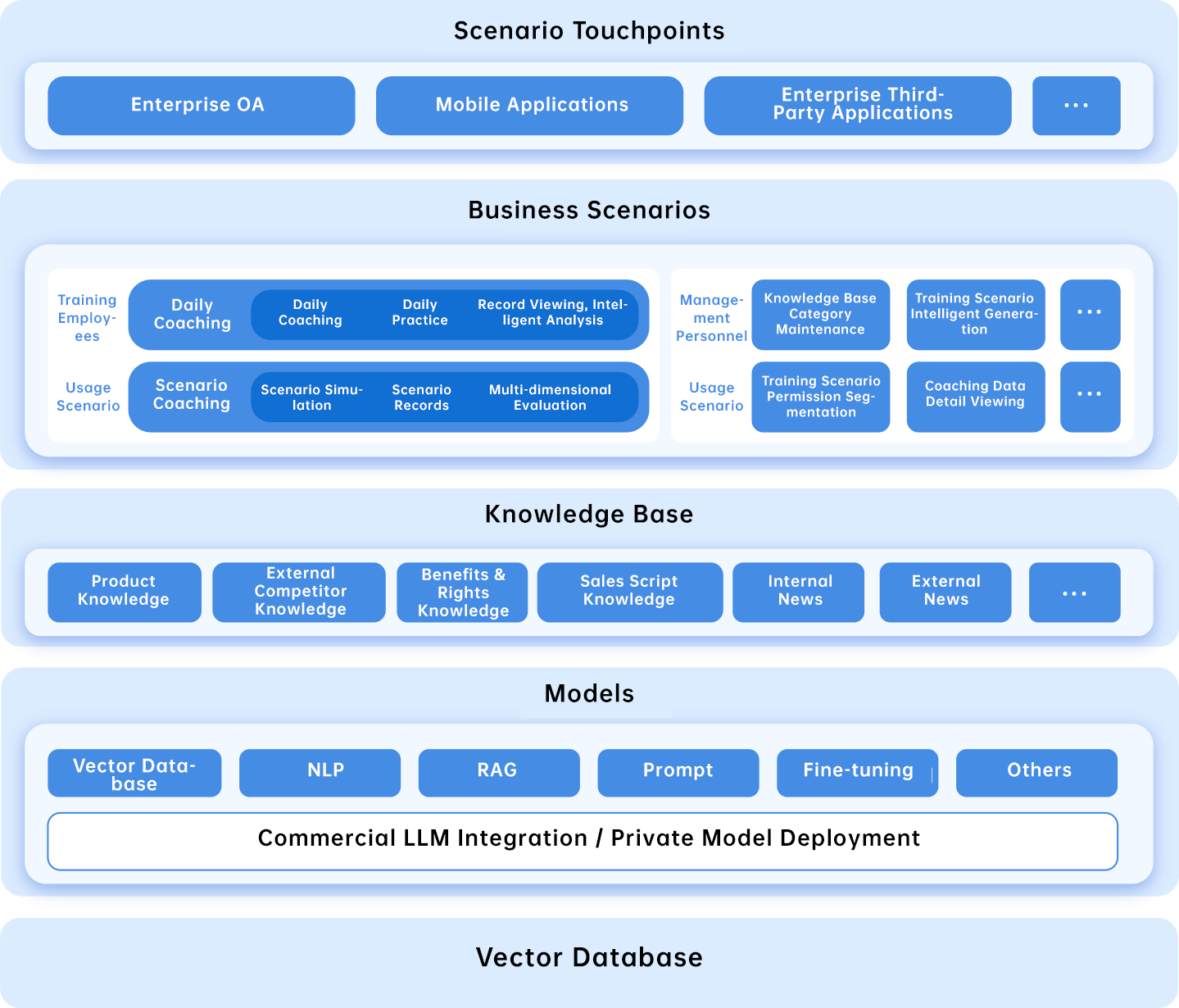

Integrate enterprise product knowledge, competitive product comparison knowledge, sales script libraries, customer equity policies, etc., updating in real-time to ensure sales personnel get the latest information.

Focusing on the entire sales process, design three core scenarios: "Daily Coaching," "Scenario Coaching," and "Practice Management."

Realize intelligent analysis of scripts through NLP and RAG (Retrieval-Augmented Generation) technologies, evaluate sales performance in multiple dimensions, and provide immediate feedback on improvement directions.
AI automatically generates sales questions and scripts, reducing instructors' repetitive teaching hours by 40%, and shortening exam design time from 3 hours to 1 hour.
Real-time monitoring of sales coaching data (e.g., "low script accuracy in a certain region," "poor objection handling scores"), precisely formulating targeted training strategies to avoid resource waste.
Daily coaching consolidates scripts, scenario coaching strengthens practical combat, and emergency capabilities are significantly enhanced.
Proficiency in product knowledge and sales scripts improves, customer inquiry responses are faster and more professional, and business processing efficiency increases.
Intelligent coaching improves sales personnel's communication skills and professionalism, enhances customer trust, and indirectly drives sales conversion improvement.
New products, new policies, competitive product response, quickly mastering basic scripts.
1. Multi-entry classification practice (product/competing product/customer questions), high-frequency split practice, directional consolidation of scripts.
2. One-click view of practice records & accuracy rates, shortcomings are clear at a glance.
3. AI provides immediate feedback on script loopholes and gives optimization suggestions.
Sales knowledge mastery efficiency increased by 70%; voice recognition accuracy reached 95%, adapting to various basic knowledge training scenarios.
Complex interactions such as customer objections, price negotiations, and closing deals; practicing real skills.
1. Simulate real sales scenarios (consultation, price comparison, objection, closing), real-time response by sales personnel.
2. Scenario practice record backtracking, supporting script review and optimization.
3. AI three-dimensional multi-dimensional evaluation, generating improvement suggestions (professionalism, response speed, demand matching, objection handling, closing awareness).
100% simulated scenarios, radar charts locate capability shortcomings, repeated practice, directional improvement.
Sales teams are large, scattered, and have high turnover; script update demands are concentrated; training effects are hard to track.
1. Dedicated personnel maintain knowledge, content updated in real-time, available on demand.
2. AI automatically generates highly simulated sales scenarios and exam questions, saving time and effort.
3. Managers view practice data to quantify everyone's learning effect.
Sales scenario and exam question generation efficiency increased by 67%; data-based control ensures full staff coverage, avoiding "slipping through the net" in training.


Copyright © 2016-2026 Digital China Group Co., Ltd. All rights reserved.